
Introduction
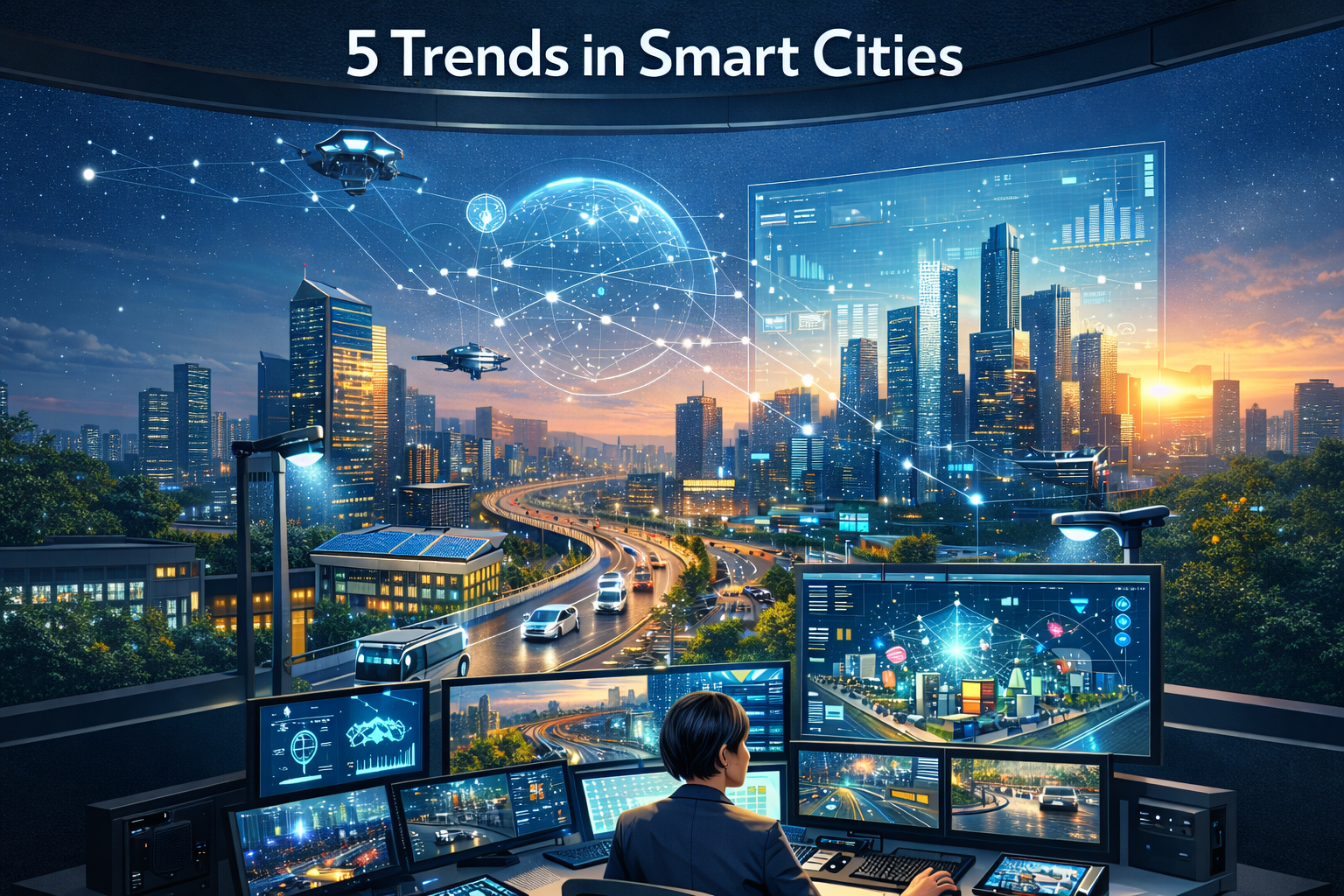
For years, the smart city story was told through gadgets: more cameras, more connected traffic lights, more dashboards glowing in control rooms. That version was never completely wrong, but it was incomplete. The cities now pulling ahead are not simply buying more technology. They are building urban operating stacks: layers of sensing, integration, decision-making, and governance that let them respond faster, plan better, and earn more public trust while doing it. OECD and UN-Habitat both frame this shift clearly: smart city success depends not just on generating data, but on governing, sharing, and using it in ways that are inclusive, transparent, and tied to real urban priorities.
Key takeaways
- Cities are shifting from isolated sensor pilots to integrated urban awareness.
- Interoperable data fabrics are becoming the backbone of city operations.
- Governance, trust, and public value now matter as much as the technology stack.
1. Cities are moving from isolated sensors to live urban intelligence
The first generation of smart-city programs often deployed sensors as standalone projects: parking here, air quality there, a pilot on streetlights somewhere else. The next generation is knitting those signals together. Cities increasingly treat cameras, IoT devices, connected infrastructure, drones, satellites, and public-system feeds as part of a broader sensing layer that continuously reflects what is happening on the ground. OECD notes that smart-city data now comes from many sources and domains, which is exactly why fragmented approaches are giving way to more integrated ones.
This matters because the value of urban sensing is no longer in the device itself. It is in the city’s ability to combine signals across mobility, infrastructure, utilities, safety, and environment. A flood sensor becomes more useful when connected to drainage data, road closure feeds, and emergency response systems. Traffic data becomes more powerful when paired with curb demand, transit performance, and air-quality readings. The trend is toward urban awareness, not just urban instrumentation. That is the real leap.
2. Data fabrics and open urban platforms are becoming the real backbone
If sensors are the nerves of a smart city, the data fabric is the connective tissue. This is one of the most important shifts underway. Cities are realizing that a city cannot act intelligently if its information lives in disconnected vendor silos. OECD highlights interoperability, co-operation, and improved data-management practices as core pillars of smart-city data governance, while open urban platform initiatives increasingly emphasize standards and interfaces that allow different systems to work together.
In practice, that means next-gen metros are investing in shared data layers rather than endless one-off integrations. These fabrics do not need to centralize every database in one place. What they need to do is make data discoverable, compatible, secure, and usable across departments. Transport, water, waste, public works, emergency response, and planning should not operate as separate digital islands.
This is also where procurement is quietly changing. The strategic question is no longer, “Which smart parking system should we buy?” It is, “Will this system plug into the city’s broader data architecture without locking us in?” Cities that get this right gain optionality. They can evolve faster, swap components more easily, and build new services on top of existing digital foundations.
3. Digital twins are shifting from flashy demos to operational tools
Digital twins have moved beyond conference-stage renderings of futuristic skylines. The more serious use case is operational: a digital twin as a living model of assets, infrastructure, and flows that helps cities monitor, simulate, and optimize what is happening in the real world. McKinsey describes digital twins as real-time virtual replicas linked to real data sources, while recent reporting has shown cities using them for climate resilience, energy management, traffic optimization, and infrastructure planning.
What makes this trend important is not visualization alone. It is decision support. A useful urban twin can help simulate how a new bus lane changes congestion patterns, how heat islands evolve across neighborhoods, where drainage failure is most likely during a storm, or how maintenance budgets should be prioritized across aging assets.
The cities getting the most value out of digital twins are not treating them as vanity projects. They are feeding them with real operational data and tying them to specific workflows: resilience planning, mobility management, infrastructure maintenance, utilities optimization, and capital planning. The twin becomes less like a glossy map and more like a management layer for the built environment.
4. Governance stacks are becoming as important as tech stacks
One lesson from the last decade is that smart cities do not fail only because of bad technology. They also fail because of weak governance. OECD’s framework stresses five pillars for smart-city data governance, including clear goals and structures, better data-management practices, privacy and transparency, interoperability, and stakeholder participation. NIST has likewise emphasized trust, transparency, community engagement, and standards in smart-city development.
That is why leading cities are building governance stacks alongside digital stacks. They are asking harder questions earlier: Who owns the data? What is shared, with whom, and under what rules? How is sensitive information protected? What counts as acceptable AI use in public services? How are vendors prevented from creating long-term dependency? How are residents included in decisions that affect them?
This is a major trend because public trust is now strategic infrastructure. A city may tolerate a clunky app. It will not easily recover from a loss of legitimacy around surveillance, biased automation, or opaque data use. The winning model is not “collect everything and explain later.” It is purposeful data use, clear safeguards, and visible accountability.
Why this matters
Trust, accountability, and public value are no longer side conversations in smart-city programs. They are core operating requirements that determine whether digital initiatives scale responsibly or collapse under social and political friction.
5. The smartest cities are becoming more people-centered, not more machine-centered
Perhaps the most important trend is philosophical. The global conversation is shifting from tech-centric smart cities to people-centered smart cities. UN-Habitat’s work explicitly frames smart-city development around inclusion, sustainability, prosperity, and human rights, rather than technology adoption for its own sake.
This changes how success is measured. A next-gen metro is not “smart” because it has thousands of sensors. It is smart if residents experience safer streets, better mobility, more resilient infrastructure, cleaner air, faster services, and fairer access to opportunity. It is smart if digital systems help city leaders allocate scarce resources better without deepening inequality or excluding communities that already sit at the edge of formal services.
In that sense, the future of smart cities looks less like a giant control room and more like a disciplined urban system: richly sensed, interoperable, simulation-capable, responsibly governed, and built around public value.