
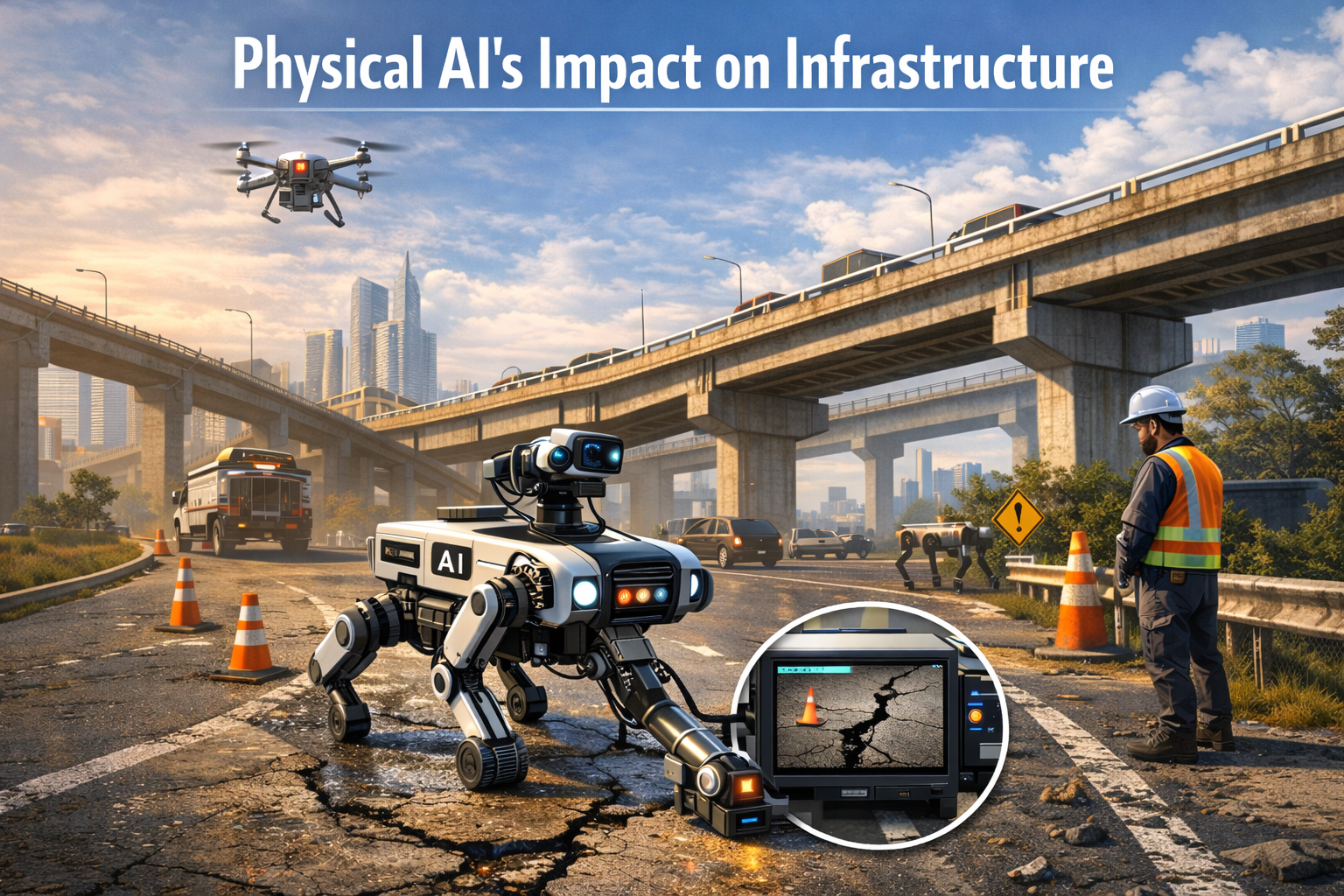
Introduction
For years, infrastructure technology has focused on monitoring the built environment from a distance: fixed sensors, periodic inspections, static asset registries, and dashboards that summarize what already happened. Physical AI changes that equation.
It brings intelligence into motion, combining perception, reasoning, and action in machines that can navigate, observe, and interact with the real world. McKinsey describes embodied AI as AI incorporated into robots that direct the actions of an object in the physical world, while recent World Economic Forum work points to physical AI as part of a broader urban transformation agenda tied to mobility, connectivity, and human-centered design.
That shift matters for cities because infrastructure is physical by nature. Roads crack. Drainage systems clog. Streetlights fail. Guardrails deform. Utility assets age unevenly. Sidewalk conditions change block by block. Traditional infrastructure management has often relied on delayed visibility: crews inspect after complaints, surveys happen on fixed cycles, and risk is inferred from sparse data. Physical AI compresses that gap between the asset and the decision. Instead of waiting for a report, cities can increasingly rely on moving perception systems that continuously observe conditions and help prioritize action. This is part of a larger trend toward AI systems that can sense and interact with the physical world at scale.
Key takeaways
- Physical AI shifts infrastructure operations from delayed visibility to continuous, in-motion awareness.
- Condition-based maintenance and earlier hazard detection can improve both productivity and public safety.
- Long-term value depends on governance: clear purpose, responsible data practices, and public trust.
Embodied perception in motion
The core breakthrough is not robotics alone. It is the rise of embodied perception stacks: combinations of cameras, lidar, radar, edge compute, spatial models, and decision software that allow machines to understand context in dynamic environments.
In infrastructure, that means a system can do more than detect an object. It can distinguish a pothole from a patch, a faded lane marking from a shadow, standing water from harmless discoloration, or a damaged sign from a temporary obstruction. Recent industry coverage and vendor ecosystems show the field moving quickly toward richer real-world perception, with physical AI models, robotics frameworks, and edge AI platforms designed specifically for complex environments.
A maintenance model upgrade
This has major implications for maintenance. Historically, maintenance has been reactive or calendar-based. Assets are serviced after failure, or inspected according to schedule whether or not the timing matches actual deterioration.
Physical AI makes condition-based maintenance more realistic across large networks. A city vehicle, roadside robot, or autonomous inspection platform can gather visual and spatial evidence continuously, flag anomalies, compare them against prior observations, and route findings into maintenance workflows. Instead of sending crews everywhere, cities can send them where risk and urgency are highest. That improves productivity, but more importantly, it changes the quality of decision-making.
Safety, labor, and infrastructure memory
Safety may be the most immediate impact. Infrastructure risk is not only about catastrophic failure; it is also about everyday exposure to hazards that accumulate quietly. A blocked drainage inlet before heavy rain, missing reflective paint on a dangerous curve, debris on a shoulder, or a misaligned traffic sign can all increase risk well before they trigger formal intervention. McKinsey notes that autonomous machines already show promise in reducing human error in physical systems, and broader physical AI analysis increasingly emphasizes safer operations in sectors where the environment is variable and labor is stretched. In urban infrastructure, that means identifying hazards earlier and reducing the time between detection and mitigation.
Another reason this matters is labor. Many infrastructure systems face persistent workforce constraints: aging field teams, hard-to-fill inspection roles, and rising service expectations. Physical AI is often framed as full automation, but the nearer-term value is augmentation. Machines and mobile sensing platforms can handle repetitive observation, first-pass triage, and dangerous or tedious inspection environments, while human teams focus on judgment, repair, and exception handling. McKinsey’s recent work on robots and workforce transformation frames the future as a partnership between people, agents, and robots rather than a simple replacement story. That framing fits infrastructure especially well.
Cities also stand to benefit because physical AI can generate infrastructure memory, not just infrastructure alerts. A single defect image is useful. A longitudinal record is far more powerful. When the same corridor or asset is observed repeatedly over weeks and months, cities gain a living history of deterioration, intervention, and change. That helps answer harder questions: which assets degrade fastest, which contractors deliver repairs that last, which neighborhoods face recurring risk, and where preventive action would save the most money. This is where embodied perception starts to connect with digital twins and broader operational systems, turning field observations into decision layers for planning, budgeting, and resilience.
Why this matters
The biggest win is not automating everything. It is giving public works teams earlier, better evidence so they can intervene before small defects become safety incidents, emergency repairs, or expensive long-term failures.
Governance and visible purpose
Still, the rise of physical AI in infrastructure should not be mistaken for a purely technical upgrade. Governance becomes even more important when intelligence moves into streets, stations, vehicles, and public spaces. The same perception stacks that can improve maintenance can also raise concerns around surveillance, opaque decision-making, procurement lock-in, and uneven deployment.
The International AI Safety Report 2026 stresses that the risks of advanced AI depend not only on capabilities but on how systems are governed and managed, and recent human-centered urban discussions reinforce that physical AI should be deployed in ways that serve people rather than overwhelm them.
That means the strongest infrastructure deployments will likely be the ones with a narrow, visible purpose. Use perception to detect roadway hazards, inspect bridges, verify repairs, assess signage, or improve worker safety. Be clear about what is being collected, how long it is retained, and what it is not used for. Separate asset intelligence from unnecessary personal data. Make the operational value legible to the public. Physical AI will scale faster where it is seen as practical infrastructure stewardship rather than ambient surveillance.