
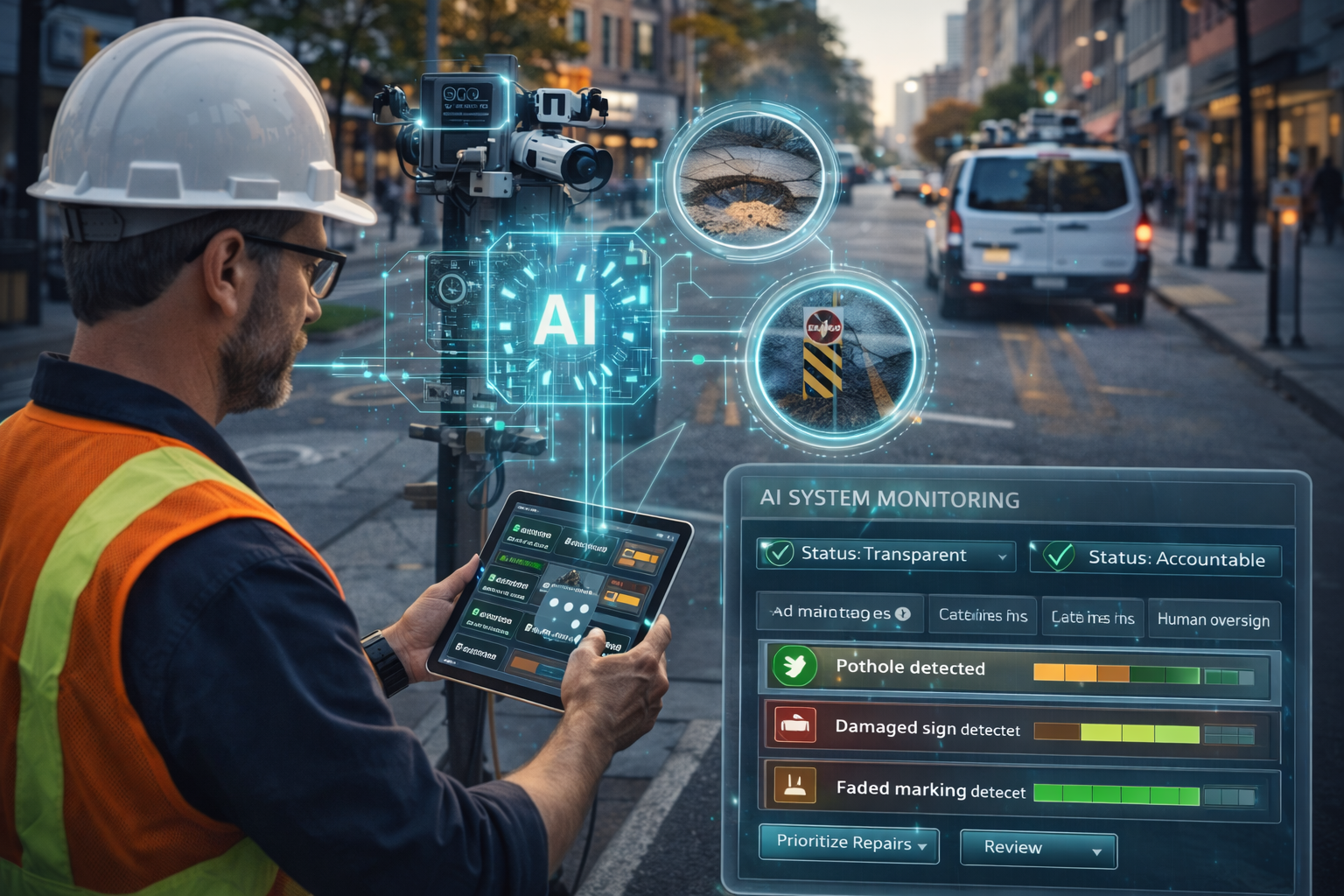
Introduction
Public infrastructure agencies are under pressure to modernize faster, reduce costs, and improve service quality. AI can help, but only if deployments are trustworthy from day one. In public systems, technical performance alone is never enough. Legitimacy, accountability, and long-term institutional trust are equally important.
A trustworthy AI approach starts with guardrails: clear purpose boundaries, privacy-conscious data practices, meaningful human oversight, transparent decision processes, and auditable operations. These are not compliance extras. They are operational requirements for AI in roads, drainage, transit, and other public assets.
When these controls are designed in early, teams can scale useful automation without creating social or governance debt.
Key takeaways
- Purpose boundaries prevent mission creep in public systems.
- Privacy controls must separate asset intelligence from personal data.
- Transparent logs and human override paths are essential for accountability.
Purpose discipline before deployment
The first governance question is simple: what exact public outcome is this model supposed to improve? For infrastructure, acceptable purposes should be concrete and service-oriented, such as detecting potholes, identifying damaged signage, or flagging blocked drainage points.
Purpose discipline means defining where the system is allowed to operate, what signals it can use, and what decisions it can influence. It also means documenting prohibited uses. Narrow, explicit scope protects both citizens and operators from mission creep.
Privacy by design in public environments
Infrastructure sensing often captures streets where people live and move. Even when the objective is asset health, surrounding personal data can appear in raw imagery or telemetry. Privacy by design requires minimizing collection, reducing retention windows, and separating asset intelligence from personally identifiable content.
Teams should apply technical controls like masking, edge filtering, role-based access, and strict retention policies. Governance should make these controls visible and enforceable through policy and monitoring, not just internal intention.
Human oversight and escalation
Trustworthy infrastructure AI keeps humans accountable for consequential actions. Models can triage and prioritize at scale, but field interventions, budget shifts, and safety-critical decisions need clear human ownership.
Strong operating models define escalation paths: when confidence is low, when detections conflict with local context, or when actions could affect vulnerable communities. Oversight should be practical, fast, and embedded in day-to-day workflows rather than treated as a formal afterthought.
Human-in-the-loop design does not slow progress. It improves reliability and protects public confidence as systems mature.
Why this matters
In public infrastructure, trust is earned operationally. The best AI program is the one citizens can understand, teams can challenge, and auditors can verify.
Transparency and auditability
Transparency means making the system legible: what data sources are used, what outputs are generated, and how those outputs influence operational decisions. Institutions do not need to publish proprietary details, but they do need clear public explanations of system purpose and safeguards.
Auditability means every material decision path can be reconstructed. Agencies should retain logs for detections, confidence levels, human overrides, and resulting actions so they can review performance, investigate incidents, and improve policy.
Together, transparency and auditability create accountability loops. They allow infrastructure AI to evolve with evidence while maintaining democratic oversight.